If you've ever used an interpreter at a legal consultation, a medical appointment, or a business meeting, you've probably experienced consecutive interpretation, even if nobody called it that.
It's the most widely used form of interpreting in everyday professional settings. This guide explains what it is, how it works, where it's used, and how it differs from other types of interpreting.
Consecutive Interpretation: The Definition
Consecutive interpretation is a mode of interpreting in which the speaker talks for a short segment and then pauses, allowing the interpreter to convey what was said in the other language. The conversation then continues, with each party taking turns.
The word "consecutive" simply means "one after another": the speaker speaks, then the interpreter interprets.
How It Works, Step by Step
The speaker says a short segment, typically a few sentences or a complete thought.
The speaker pauses.
The interpreter conveys the full message in the other language, accurately and completely.
The other person responds, and the interpreter conveys that response back.
The process repeats throughout the conversation.
Interpreters often take brief notes during longer segments, using a specialized note-taking system to capture names, numbers, dates, and the structure of what was said. This is one of the core skills of professional consecutive interpreters.
Where Consecutive Interpretation Is Used
Consecutive interpretation is the standard mode in settings where accuracy and two-way conversation matter most:
Legal settings: consultations with lawyers, depositions, examinations for discovery, and many court and tribunal proceedings
Medical settings: appointments, consultations, diagnoses, and informed consent discussions
Immigration settings: interviews and hearings
Business settings: meetings, negotiations, site visits, and small-group discussions
Education and community services: parent-teacher meetings, settlement appointments, and government offices
It works in person, over the phone, and over video.
Consecutive vs. Simultaneous Interpretation
The other main mode of interpreting is simultaneous interpretation. Here is how the two compare:
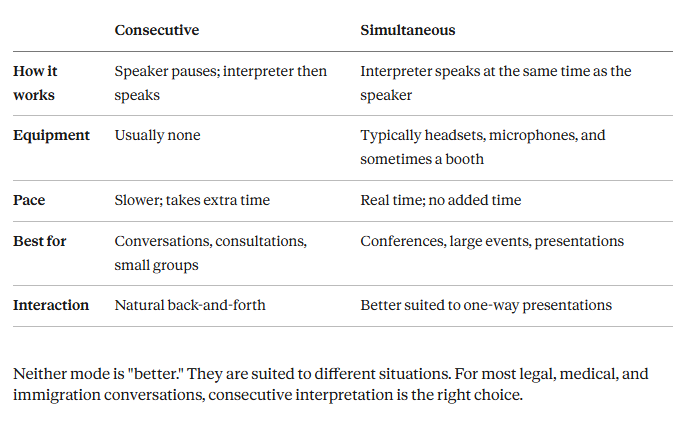
Advantages of Consecutive Interpretation
High accuracy. Because the interpreter hears a complete thought before speaking, they can choose the most precise wording.
No special equipment. It can be done anywhere, at short notice, with no technical setup.
Natural conversation. It supports a real back-and-forth between people, which is essential in consultations and negotiations.
Flexible. It works for one-on-one conversations and small groups, in person or remotely.
Things to Keep in Mind
It takes more time. Because everything is said twice, an interpreted conversation takes roughly twice as long as one in a single language. Plan extra time into appointments and meetings.
Speak in manageable segments. Very long, uninterrupted speech is harder to convey accurately. Pausing regularly helps the interpreter, and helps everyone follow along.
Speak to the person, not the interpreter. Address the other party directly, as if the interpreter weren't there.
Use plain language. Avoid slang, idioms, and heavy jargon where possible.
What Makes a Good Consecutive Interpreter?
Consecutive interpreting is a skilled profession. A qualified interpreter should have:
Strong command of both languages, including relevant dialects
Excellent listening and memory skills, supported by professional note-taking
Knowledge of specialized terminology in the relevant field, such as legal or medical vocabulary
Professional ethics, including neutrality, accuracy, and confidentiality
Training and certification recognized in their field
This is why a bilingual friend or family member, however well-meaning, is rarely a substitute for a professional interpreter in important settings.
Book a Certified Consecutive Interpreter in Ontario
PRO Interpreting Canada provides certified interpreters across Ontario for legal, medical, immigration, educational, and business settings, in person, over the phone, or via video, in a wide range of languages and dialects.
If you're not sure whether you need consecutive or simultaneous interpretation, contact us. We'll recommend the right approach for your situation.