When you need an interpreter, one of the first questions you'll face is how you want to receive the service. Should the interpreter attend in person? Join by phone? Or connect over video?
There's no single right answer. Each format has real strengths, and the best choice depends on your situation: how urgent it is, how complex or sensitive the conversation is, where everyone is located, and what's at stake.
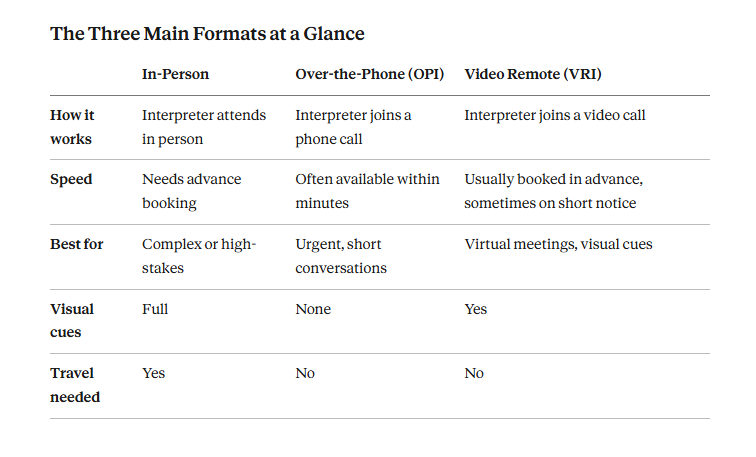
This guide explains the three main formats, when each works best, and how to decide.
In-Person Interpreting
With in-person interpreting, a professional interpreter attends your appointment, hearing, or meeting at the location.
When it works best
Court hearings and legal proceedings, where precision and presence matter
Complex medical consultations, such as a serious diagnosis, surgery planning, or informed consent
Mental health appointments, where tone, emotion, and trust are central
Immigration hearings and interviews
Long meetings, negotiations, and conferences
Situations involving several people, where an interpreter needs to manage the flow of the conversation
Advantages
The interpreter can see the whole room, read body language and tone, and respond to the dynamics of the conversation. For sensitive or emotional discussions, the physical presence of a professional can also be reassuring.
Things to consider
In-person interpreting needs advance booking and involves travel time. It is typically billed by the hour, usually with a minimum booking period. For less common languages, availability in a specific city may be more limited.
Over-the-Phone Interpreting (OPI)
With OPI, a professional interpreter joins a live telephone call between you and the other party. It's fast, flexible, and requires no travel.
When it works best
Urgent situations where you need an interpreter right now
Short conversations, such as a quick medical question, a pharmacy call, or a customer service inquiry
Walk-in situations where no interpreter was booked in advance
Rare languages, where an interpreter may not be available locally but can connect remotely
Follow-up calls with clients, patients, or government offices
Advantages
OPI is typically the fastest way to reach an interpreter, often within minutes. It's billed by the minute, so it can be very cost-effective for short conversations. At PRO Interpreting Canada, OPI starts from $1.50 per minute.
Things to consider
Because there's no video, the interpreter can't see facial expressions or gestures. For very complex, sensitive, or long conversations, another format may be a better fit.
Video Remote Interpreting (VRI)
With VRI, a professional interpreter joins your meeting over video, using a platform such as Zoom, Microsoft Teams, or Google Meet.
When it works best
Virtual meetings and hearings, where the interpreter joins the same call as everyone else
Telehealth appointments, where visual cues help
Business meetings with remote participants
Situations where seeing the speaker helps comprehension, but travel isn't practical
Advantages
VRI offers much of the benefit of in-person interpreting, including visual cues, without the travel. It's well suited to today's hybrid and remote working environments, and it opens access to interpreters in less common languages wherever they are located.
Things to consider
VRI depends on a stable internet connection and a suitable device. It works best when everyone has tested their audio and video beforehand.
How to Choose: Four Questions to Ask
1. How urgent is it? If you need an interpreter immediately, OPI is usually the fastest route. If you can plan ahead, any format is possible.
2. How complex or sensitive is the conversation? The higher the stakes, or the more emotional the subject, the stronger the case for in-person interpreting, or video as a second choice.
3. How long will it take? Short calls suit OPI. Long meetings, hearings, and full-day events are usually better with an in-person or video interpreter.
4. Where is everyone located? If participants are in different places, or an interpreter in your language isn't available locally, remote options bring the interpreter to you.
Can You Combine Formats?
Yes. Many clients use a mix. For example:
A medical clinic might use OPI for walk-in patients and in-person interpreters for scheduled specialist appointments.
A law firm might use in-person interpreters for hearings and depositions, and VRI for client consultations with people in other cities.
A business might use VRI for regular remote meetings and in-person for major negotiations.
A good interpreting provider will help you build the right mix for your needs.
Whichever Format You Choose, Quality Matters
The format is only part of the picture. For any interpreted session to work, the interpreter should be:
Certified and professionally trained
Experienced in your setting, such as legal, medical, or immigration
Matched to the right language and dialect
Bound by confidentiality and professional neutrality
Get Help Choosing
PRO Interpreting Canada provides certified interpreters across Ontario in all three formats: in person, over the phone, and via video. If you're not sure which is right for your situation, contact us. We'll recommend the best fit for your appointment, language, and timeline.